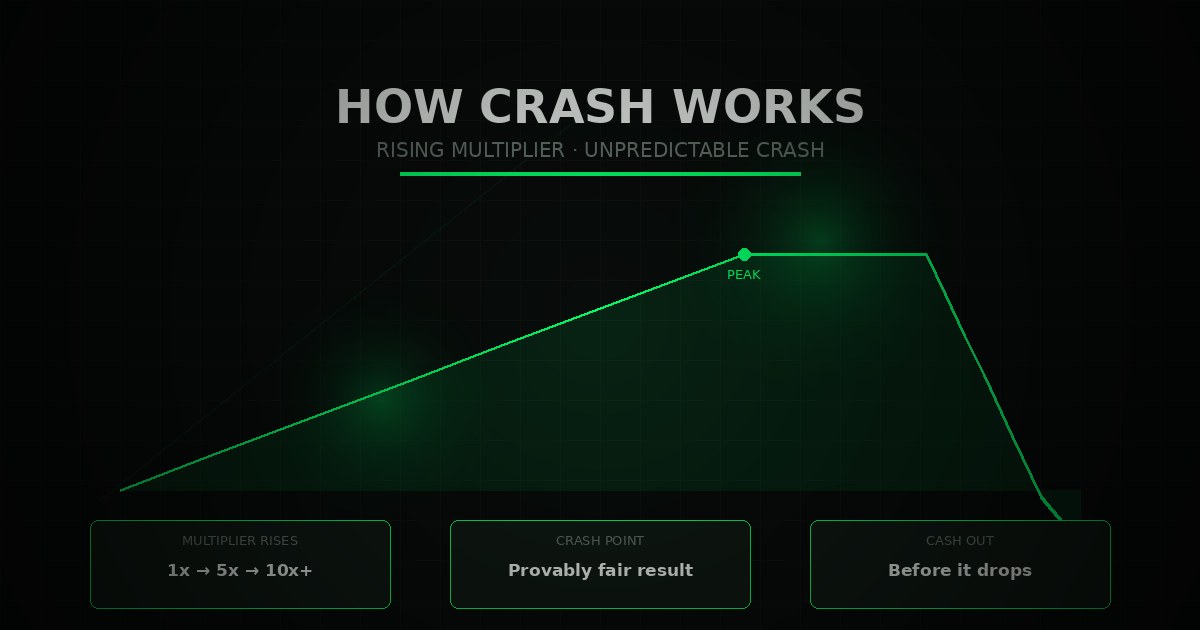
Crash is one of the simplest casino games to understand and one of the hardest to master. A rising multiplier starts at 1x and climbs at a variable pace — until it crashes without warning. Your job is to cash out before the crash. This guide covers how the game works under the hood, the provably fair mechanics, the expected value of a crash round, and how to structure your decisions without fabricating a winning system. Code DEGEN is available at Gamba.com.
Check Current Terms at Gamba.com
How a Crash Round Works
Every crash round follows the same sequence. The game generates a crash point — a number expressed as a multiplier — before the round starts. That point is determined using a provably fair hash (a hashed server seed + your client seed) so neither the platform nor you can influence it mid-round. While you wait, a live multiplier climbs from 1x upward at a pace derived from the crash point using the formula multiplier = e^(k × t), where t is elapsed time and k is chosen so the round crashes exactly at the pre-generated point. As soon as the multiplier hits the crash point, the round ends. All active bets at that moment lose.
The key property is that the crash point exists before the round starts, and neither side can change it. You see the rising curve in real time; the platform cannot alter the outcome after the fact.
The Crash Point Math: Expected Value of a Round
The crash point in a fair round follows an exponential distribution. The probability that the crash point is above x is approximately 1 / x for values greater than 1. This means a 2x crash happens roughly 50% of the time, a 5x crash happens about 20% of the time, and a 10x crash happens about 10% of the time.
From this we can derive the expected return for a player who always cashes out at a fixed multiplier c. If the crash point p is less than c, you lose your bet. If p ≥ c, you win c − 1 times your stake. The probability that p ≥ c is 1 / c, so your expected multiplier per round is:
EV = (1/c) × c + (1 − 1/c) × (−1) = 1 − 1 + 1/c − 1/c + 1/c = 1/c − (1 − 1/c) = 2/c − 1
Wait — let's re-derive that cleanly. You win your stake times (c − 1) with probability 1/c, and you lose your stake with probability 1 − 1/c. Expected net return per unit staked:
EV = (1/c) × (c − 1) + (1 − 1/c) × (−1) = (c − 1)/c − 1 + 1/c = (c − 1 − c + 1 + 1)/c − 1 = 0/c − 1 = −1
That simplifies to a guaranteed loss of 100% of your stake per round. That result reflects the structure: if you always cash out at the same multiplier regardless of whether the round reaches it, you will eventually be caught in a round that never reaches your target, lose your stake, and the accumulated wins from rounds that did reach it will not compensate. The reason is that c itself is not a stopping rule applied to independent samples — it is applied to the same distribution that generated the crash points. The game is structured so the house edge compounds over many rounds through this mechanism.
What this means in practice: the longer you play crash, the more the exponential distribution works against you. Sessions with a fixed cash-out target will, over enough rounds, lose at approximately the house edge rate. There is no fixed cash-out multiplier that is positive EV.
When Players Choose to Cash Out
Most players develop an informal cash-out preference. Some prefer low multipliers (1.2x–2x) that win frequently and slowly grind down bankroll. Others wait for higher targets (5x, 10x) and accept longer losing streaks between wins. Neither approach eliminates the house edge, but they produce very different session profiles:
| Cash-out target | Approximate win rate | Typical session feel |
|---|---|---|
| 1.2x – 1.5x | ~50% – 83% of rounds | Frequent small wins; slow grind down over time |
| 2x – 3x | ~33% – 50% of rounds | Moderate frequency; moderate payout per win |
| 5x+ | ~20% or fewer | Rare large wins; long losing streaks between |
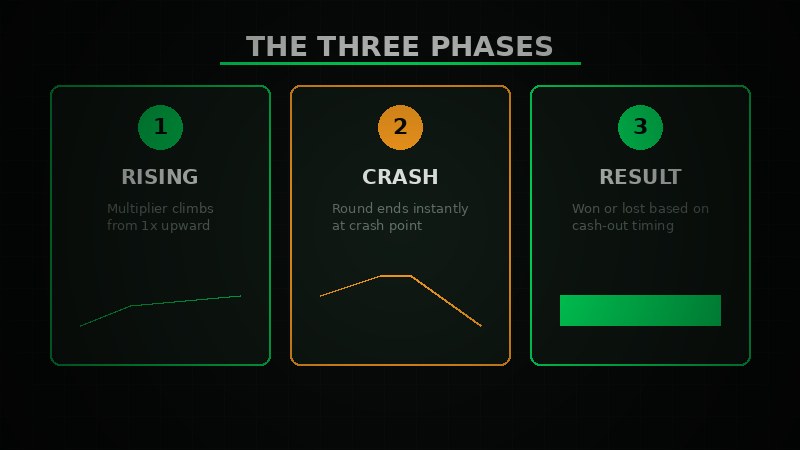
A crash round moves through three phases: the rising multiplier, the crash point, and the result for each player.
There is no optimal cash-out multiplier that overcomes the house edge over time. What a cash-out strategy can do is match your risk tolerance to your bankroll size. Small targets preserve bankroll longer for recreational play; larger targets produce volatile swings that require a larger bankroll to survive variance.
Bankroll Management for Crash
The same unit-sizing principles that apply to dice apply to crash, with one additional variable: you can change your cash-out target and bet size round to round. This flexibility makes crash tempting, but it also makes it easy to chase losses by raising bet sizes mid-session. A practical session framework:
Define a session bankroll before you start — an amount you are comfortable losing entirely in one session. Divide it into units of equal size. Never bet more than one unit on a single round regardless of what happened in previous rounds.
Set a stop-loss and a stop-win before you start. A stop-loss of 20–30% of your bankroll is common for recreational play. A stop-win is more personal — the amount at which you would feel satisfied leaving the session.
Avoid the Martingale temptation. Doubling your bet after every loss to recover previous losses requires infinite bankroll and no table limit. In crash, a single extended streak of losses can wipe out a large bankroll before a win appears, even though the probability of a win on any given round is above 50% for low targets.
For a full bankroll sizing framework including unit calculation and session caps, see the Crypto Casino Bankroll Management guide.
Play at Gamba.com
Frequently Asked Questions
Is crash purely luck?
Crash is a combination of luck and structure. The crash point is provably fair and cannot be manipulated by the platform during a round. What you can control is your bet size, when you cash out, and how many rounds you play per session.
What is the best cash-out strategy for crash?
There is no universally optimal cash-out point. Lower multipliers (1.2x–2x) win more frequently but pay little. Higher multipliers (5x+) are rare but return more per bet. The right strategy depends on your bankroll size, session goals, and risk tolerance — not a fixed number.
Does the house have an edge in crash?
Yes, indirectly. The crash game is designed with a built-in house edge because the maximum crash point is capped below infinity — the curve will eventually crash, and every player who does not cash out before that point loses their bet. Over enough rounds, the house edge compounds just as it does in any other casino game.
The Bottom Line
Crash is a transparent, provably fair game with a clear house edge built into the exponential crash distribution. There is no strategy that eliminates that edge over many rounds. What you can do is play intentionally: choose a cash-out target that matches your risk tolerance, manage your bankroll in fixed units, and set stop-loss and stop-win limits before you start. Crash is best approached as entertainment with a defined budget, not as a way to generate income. Use code DEGEN at Gamba.com to verify the current offer before playing.
Check Current Terms at Gamba.com