
The fastest way to lose money at a crypto casino has nothing to do with the house edge and nothing to do with picking the wrong game. It is poor bankroll management: bet sizing that drifts after a few wins, no stop-loss rule, no separation between "session money" and "next month's rent," and no plan for what happens during the inevitable ten-bet losing streak. This guide covers the five numbers every player should write down before they deposit: total bankroll, unit size, session bankroll, stop-loss, and stop-win. The math is simple. The discipline is the hard part.
Open Gamba with DEGEN
The Five Numbers Every Player Needs
Before you place a single bet at a crypto casino, write down five numbers on paper or in a notes file. These five numbers are the entire bankroll management system; everything else in this guide is a tool for staying inside them. If you skip this step, every other rule in the article will eventually break, because there is no anchor for "how much can I lose tonight" without them.
| Number | What It Is | Typical Starting Value |
|---|---|---|
| Total bankroll | Money you can afford to lose entirely without affecting rent, bills, or savings. | Whatever fits your budget; treated as a closed bucket. |
| Unit size | 1%–2% of total bankroll. The fixed chip you bet with. | 1%–2% of total bankroll. |
| Session bankroll | 5%–10% of total bankroll. The max you bring into one sitting. | 5% of total bankroll (the "5% rule"). |
| Stop-loss | Session loss that ends the night, regardless of how "due" a win feels. | 30%–50% of session bankroll. |
| Stop-win | Session profit at which you cash out and walk away. | 30%–50% of session bankroll. |
The percentages above are common starting points used by sports bettors and poker players. Tighter or looser ranges can work depending on the game and your personal tolerance, but the structure — bankroll, unit, session, stop-loss, stop-win — is what matters.
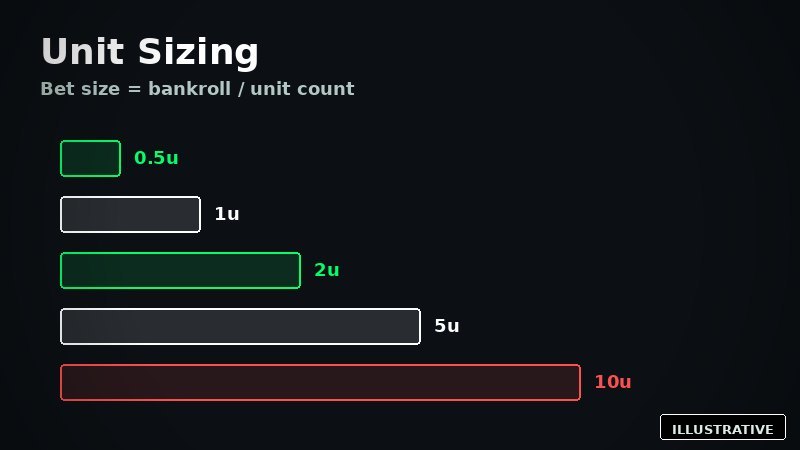
Illustrative: a unit-size ladder showing how bet size scales from a fixed unit. Most disciplined players never bet above 2u–3u per wager, even after a winning streak.
Unit Sizing: The Foundation of Everything Else
A "unit" is the fixed fraction of your bankroll that you bet per wager. If your total bankroll is $500 and your unit size is 1%, one unit equals $5 — and every bet you place, win or lose, is sized as some multiple of that $5. The unit is what makes bet sizing consistent. It is what stops you from chasing a loss by doubling your bet on impulse, and it is what stops you from getting overconfident after a winning streak and betting 5x your normal size on the next round.
The two most common unit sizes are 1% and 2% of total bankroll. 1% is the more conservative choice and is favored by players who treat gambling as a long-term hobby rather than a way to make money. 2% allows more action per session and is common in higher-variance games like crash or limbo, where a series of small wins followed by one big miss is the typical pattern. Both are defensible; what is not defensible is a unit size above 5%, where a normal losing streak can wipe out half your bankroll before you have time to react.
Your unit size should also track your current bankroll. If you start at $500 with a 1% unit ($5), and your bankroll grows to $650 after a good week, your new unit is $6.50. If your bankroll drops to $350 after a bad week, your new unit is $3.50. This recalibration is the single most important habit in bankroll management. It is what turns "I had a great night and now I'm betting $50 a hand" into "I had a great night and my next bet is still one unit."
Never increase your unit size because you are winning. Increase it because your bankroll is higher. The difference matters: a bankroll-based unit size scales with reality, while a streak-based unit size scales with emotion. Emotion is what blows up bankrolls.
The 5% Rule and Why It Exists
The 5% rule says that no single session should ever contain more than 5% of your total bankroll. A tighter version caps sessions at 1%–2% of total bankroll. Both are designed to answer one question: "How much can I lose tonight before I should stop playing?" If your total bankroll is $1,000 and you cap each session at $50, then even a worst-case session can only ever cost you 5% of what you have, and ten losing sessions in a row still leaves you with half your bankroll.
This is not a theoretical risk. Long losing streaks are a normal feature of every casino game, including low-edge originals. Dice at a 1% house edge will routinely produce ten-bet losing streaks and even twenty-bet losing streaks. Crash at high cash-out multipliers can produce ten-bet losing streaks in a row during normal play. Without a session cap, a player who keeps clicking "bet" through a streak can burn through an entire bankroll in under an hour.
The 5% rule is also what separates "I lost a fun Saturday night" from "I lost next month's rent." If you sit down with money you cannot afford to lose, you are not budgeting — you are gambling with rent money. The rule forces you to define the loss budget up front, in dollars, before the session begins. That number, written down before the first bet, is the only thing that reliably ends a session.
Stop-Loss and Stop-Win: Two Rules, Same Idea
A stop-loss is a session loss that ends the night, full stop. Common values are 30%–50% of session bankroll. With a $50 session and a 50% stop-loss, you stop playing once you are down $25 — even if you feel like you are "due" to win, even if the next bet feels like a sure thing, even if your friend says "one more." The stop-loss is the line you do not cross.
A stop-win is the same idea on the upside. With a $50 session and a 50% stop-win, you stop playing once you are up $25. Cashing out at that point is the entire point of stop-win rules. The single biggest source of wiped bankrolls is not losing — it is winning, getting overconfident, and then losing it all back and more. A 30%–50% stop-win turns "I made $50 tonight" into a repeatable outcome instead of a one-time event.
The most common beginner mistake is to set a stop-loss but no stop-win. The second most common is to set both numbers and then ignore them. The third is to reset the numbers mid-session because you are up and want to keep playing. None of these are negotiable. The stop numbers are the contract you sign with yourself before the session starts, and the only valid reason to leave the table early is to come back tomorrow.
Why This Matters Across Different Games
Bankroll management interacts with house edge and variance in different ways across games. On dice and crash — low house edge, predictable variance — a 1%–2% unit and a 50% session stop gives you a long runway and most sessions end as small wins or small losses, which is exactly what the math wants. On slots and live game shows — high house edge, high variance — the same unit size will see your session bankroll evaporate faster, and the stop-loss rule becomes more important because each spin or round costs you more in expectation. See our crypto casino house edge by game guide for the full per-game math, and our RTP explainer for why the difference between a 1% edge and a 5% edge compounds over hundreds of bets.
Sports betting is the same framework with a different shape. A 1%–2% unit on a typical -110 line means risking 1.1%–2.2% of bankroll per bet to win 1%–2%. Variance is higher than dice (you might go 0-for-15 in a weekend without doing anything wrong), so the session-cap and stop-loss rules matter even more. If you mix casino games and sports on the same bankroll, treat them as one pool — your unit size is set by the combined balance, not by which vertical you happen to be playing.
The Common Failure Modes
Three patterns account for most wiped bankrolls at crypto casinos. The first is "I'll just bet a little more to make it back" — a small loss turns into a chase, the chase turns into a larger loss, and the cycle repeats until the session bankroll is gone. The second is "I won $200, let me ride this" — a stop-win is ignored because the player feels locked in, and the next twenty bets give it all back. The third is "I deposited another $200 to keep playing" — the session bankroll cap is exceeded mid-session because the player kept topping up.
All three are the same mistake: the rules exist for a reason, and breaking them always costs more than following them. A session that ends at a small loss because you respected the stop-loss is a successful session, not a failure. A session that ends at a small profit because you respected the stop-win is a successful session. A session where you broke both rules is the session that wipes your bankroll.
Play at Gamba.com
Frequently Asked Questions
What is the 5% rule in crypto casino bankroll management?
The 5% rule is a guideline that says you should not commit more than 5% of your total bankroll to a single active session. A tighter version uses 1–2% per session. Both are designed to keep a normal losing streak from blowing up your entire bankroll across a single weekend.
What is a unit in bankroll management?
A unit is a fixed fraction of your bankroll, usually 1%–2%. If your bankroll is $500 and your unit size is 1%, one unit equals $5. Betting one unit per wager keeps your bet size consistent regardless of whether you are up or down, which is the single biggest difference between disciplined and undisciplined play.
Should I increase my bet size after a winning streak?
No. Bet size should track your total bankroll, not your last few results. If your bankroll grows by 20%, your unit size grows by 20%. If your bankroll drops by 30%, your unit size drops by 30%. Increasing bet size after wins is the most common path from a winning night to a wiped bankroll.
The Takeaway
Bankroll management is not about guaranteeing wins. It is about guaranteeing that a bad night does not end your hobby and that a good night actually stays a good night. Write down your five numbers before you deposit: total bankroll, unit size (1%–2%), session bankroll (≤5%), stop-loss (30%–50% of session), and stop-win (30%–50% of session). Set them in a notes file. Adjust unit size as your bankroll changes. Never top up mid-session, and never extend the stop numbers because the next bet feels obvious.
Do all of that, and you will not eliminate variance — that is impossible at any house edge — but you will make your results predictable enough that you can keep playing for months or years, instead of one weekend. If an account-specific offer is shown after entering code DEGEN, read the live game-contribution, wagering, max-bet, and withdrawal terms before depositing. The promotion changes constantly; the bankroll math does not.
Check Current Terms at Gamba.com