Slot volatility explained in one sentence: it describes how unevenly a game's payouts tend to arrive. Low-volatility slots usually return more of their theoretical payout through frequent smaller wins; high-volatility slots usually concentrate more of it in less frequent larger wins. Volatility does not tell you whether a slot is generous, fair, or profitable. It tells you what the ride may feel like while the house edge works in the background.
Check Current Terms at Gamba.com
What Slot Volatility Actually Measures
Volatility, often called variance in casino guides, describes the spread of possible short-term results. Imagine two slots with the same published return-to-player percentage. One may pay back small amounts on many spins, keeping the balance relatively stable. The other may produce long dry stretches interrupted by occasional large payouts. Their long-run expected return can be identical even though one balance chart looks calm and the other looks violent.
That distinction matters because players experience a few dozen or a few hundred spins, not the enormous sample used to describe theoretical return. During a short session, volatility can dominate what you see. A high-volatility slot can lose repeatedly despite having the same RTP as a calmer game. A low-volatility slot can produce many "wins" that are smaller than the original stake, so frequent animations do not necessarily mean the balance is increasing.
RTP vs Volatility: Expected Return vs Distribution
RTP and volatility answer different questions. RTP asks, "How much of total wagering is expected to return to players over a very large sample?" Volatility asks, "How concentrated or spread out are those returns?" House edge is simply the complement of RTP: a hypothetical 96% RTP implies a 4% house edge before any separate fees or promotional effects. Volatility does not remove that edge and does not create a winning system.
The easiest way to see the difference is with three simplified toy games. Each hypothetical game below returns $0.96 in expectation per $1 spin, so each has the same 96% illustrative RTP. The payout patterns are deliberately simple to isolate volatility; they are not descriptions of real slot paytables.
| Illustrative Game | Simplified Payout Pattern | Expected Return per $1 Spin |
|---|---|---|
| Lower volatility | 96% chance to receive $1; 4% chance to receive $0 | 0.96 × $1 = $0.96 |
| Medium volatility | 24% chance to receive $4; 76% chance to receive $0 | 0.24 × $4 = $0.96 |
| Higher volatility | 4% chance to receive $24; 96% chance to receive $0 | 0.04 × $24 = $0.96 |
Illustrative math only. Real slots use many symbols, paylines, features, and payout levels. Always read the current game information and paytable.
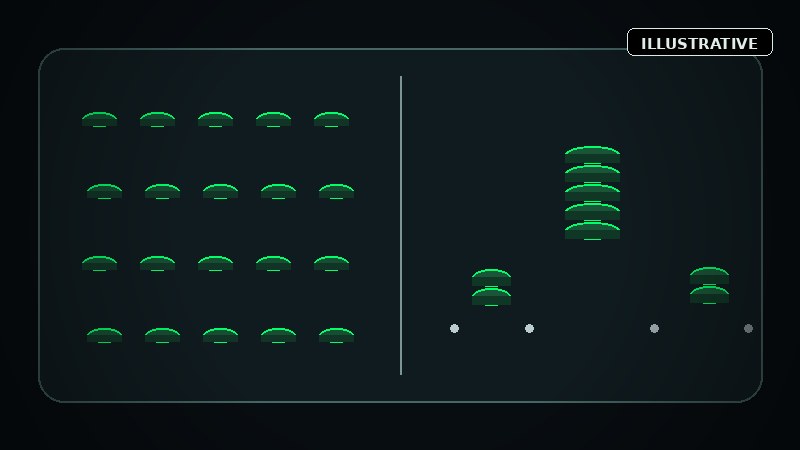
Illustrative: frequent smaller outcomes on the left and sparse larger outcomes on the right. No real game data is shown.
Low, Medium, and High Volatility Compared
Low-volatility slots generally emphasize frequent smaller payouts. They tend to suit longer sessions, smaller balance swings, and players who value time-on-game over rare large outcomes. "Frequent" does not mean profitable: a $0.40 return on a $1 spin is still a $0.60 net loss, even if the interface celebrates it as a hit.
Medium-volatility slots sit between the extremes. Their paytables usually combine recurring base-game payouts with bonus features or less frequent higher multipliers. The label is broad, so two medium-volatility games may still feel very different. Treat it as a starting category, not a precise statistical guarantee.
High-volatility slots generally direct more theoretical return toward uncommon larger outcomes. That creates longer losing stretches and sharper balance swings. A high maximum payout can be part of the design, but max payout alone does not prove volatility because the probability and contribution of that outcome also matter.
Hit frequency is useful but incomplete. It counts how often qualifying payouts occur, not whether those payouts exceed the stake or how large the rare outcomes are. Use volatility, RTP, paytable, and bet size together.
How to Check a Slot's Volatility Before Playing
Start with the official game information panel. Some providers publish a low, medium, or high volatility label; others use a scale or provide no volatility rating at all. Then inspect the paytable and feature structure. A game that places much of its advertised potential behind rare bonus rounds, expanding multipliers, or top-symbol combinations will usually produce less even results than one built around frequent base-game payouts.
Do not classify volatility from a short personal sample. Ten wins in twenty spins does not prove a game is low volatility, and one large payout does not prove it is high volatility. Random outcomes cluster. Unless the provider publishes the model or you have a very large dataset, personal session history is weak evidence.
Also separate volatility from outcome verification. A provably fair mechanism may let you verify that an outcome was generated from committed inputs, but it does not tell you the game's RTP, payout distribution, licensing status, or withdrawal reliability. For third-party slots, the provider's published game information is the relevant source for RTP and any volatility label.
Match Volatility to Bankroll and Session Length
Volatility becomes practical when it changes bet size. A high-volatility game needs more room for normal losing stretches, so using the same stake that feels comfortable on a low-volatility game can shorten the session dramatically. If the goal is a fixed amount of entertainment time, lower the stake as volatility rises instead of increasing deposits after losses.
Use the framework in our crypto casino bankroll management guide: define a total entertainment bankroll, a session cap, and a stop-loss before playing. Volatility does not provide a magic unit size, but it does tell you when a conservative stake matters more. Never use money reserved for bills, savings, debt payments, or essential expenses.
Bonus play adds another layer. Game contribution, maximum-bet rules, excluded titles, and expiry can matter more than volatility when clearing an offer. Read our wagering requirements explainer and verify the live terms instead of assuming a low-volatility slot is automatically efficient for wagering.
Review Gamba's Current Terms
Common Slot Volatility Myths
"High volatility means better jackpots." A high-volatility design may concentrate return in larger prizes, but the maximum displayed payout says nothing by itself about expected value or the chance of reaching it. "Low volatility means safer." It generally means smoother short-term swings, not protection from loss; the house edge still compounds with wagering volume. "A slot that has not paid is due." Independent random outcomes do not become more likely because previous spins lost. "More wins means higher RTP." A game can register frequent payouts below the stake while returning less overall than a game with fewer but larger payouts.
Frequently Asked Questions
What does volatility mean in slots?
Slot volatility describes how widely short-term results tend to swing around a game's long-run expected return. Low-volatility slots generally concentrate more of their return in frequent smaller payouts, while high-volatility slots generally concentrate more return in less frequent larger payouts.
Is high or low volatility better for slots?
Neither is universally better. Low volatility usually fits longer sessions and smaller bankroll swings. High volatility fits players who accept longer losing stretches for a chance at less frequent larger payouts. RTP and game rules should still be checked separately.
Does high volatility mean a slot has lower RTP?
No. Volatility and RTP measure different things. RTP describes long-run expected return, while volatility describes how unevenly that return is distributed across outcomes. Two games can publish the same RTP and still produce very different short-term balance swings.
The Takeaway
RTP tells you the long-run expected return; volatility tells you how rough the path may be. Low volatility generally means more frequent smaller payouts and smoother sessions. High volatility generally means longer dry stretches with more return concentrated in uncommon larger outcomes. Neither profile beats the house edge, and neither predicts the next spin.
Before playing, check the current game information, compare RTP separately, inspect the paytable, choose a stake that fits the volatility, and set a hard session limit. If an account-specific offer appears after entering code DEGEN, verify its current eligibility, game contribution, maximum-bet, wagering, and withdrawal terms in the official signup flow.
Check Current Terms at Gamba.com