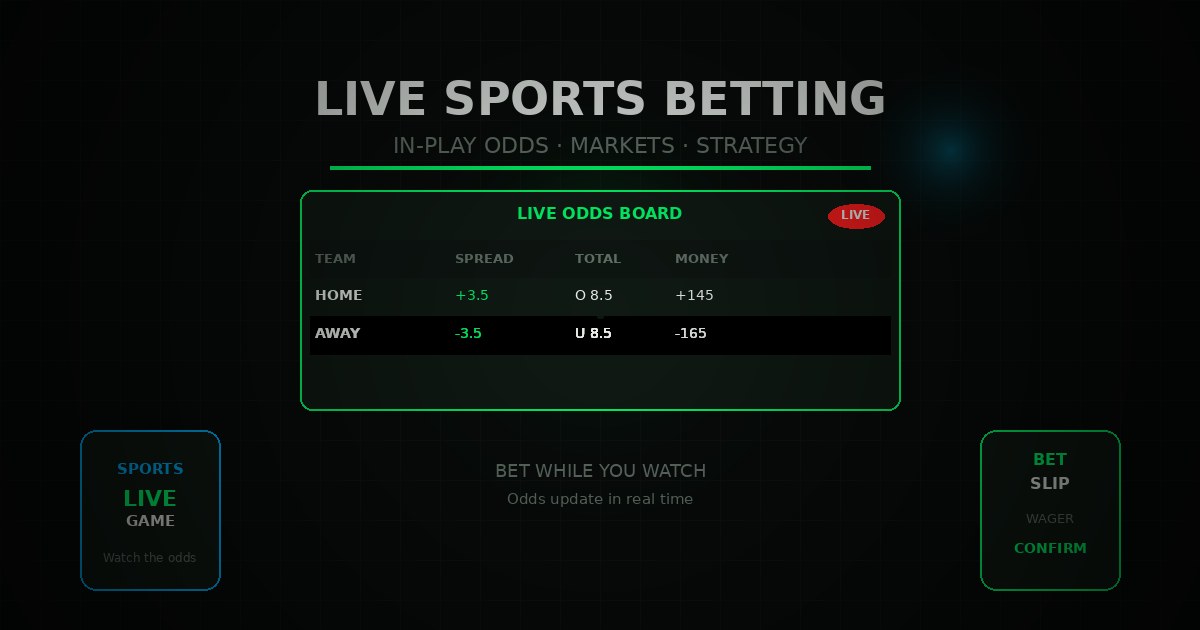
Live sports betting — also called in-play or in-game betting — lets you wager on a game after it has started. Odds update every few seconds, reacting to what happens on the field: a goal scored, a key player going off injured, a momentum shift in the scoreline. The speed creates both opportunity and risk. This guide covers how in-play odds work, which markets are available mid-game, and how to approach live betting without letting the pace override disciplined bankroll management. Code DEGEN is available at Gamba.com.
Check Current Terms at Gamba.com
How In-Play Odds Move
Pre-game odds are set by odds compilers hours or days before a match. In-play odds are managed by algorithmic trading systems that update prices continuously based on the current scoreline, time remaining, market volume, and the probability of each outcome at that specific moment. The faster cycle means odds can swing significantly during a single game.
The key difference from pre-game betting is that in-play odds reflect a real-time probability estimate. When a favourite goes a goal down early, their win odds lengthen immediately. If they equalise, the odds tighten again. These movements are information-driven — the market is reacting to events, and the speed of that reaction is faster than any single bettor can manually track.
There is a vig embedded in in-play markets, just as in pre-game markets. The vig is the difference between the true probability of an outcome and the probability implied by the offered odds. In-play vig tends to be wider than pre-game vig because the faster pace and higher turnover reward the bookmaker more for volume.
Common In-Play Markets
The range of available in-play markets varies by sport and platform. These are the most common:
| Market | Description | When it is most useful |
|---|---|---|
| Moneyline | Win/draw/outcome of the match | When one team is dominant and the odds reflect it |
| Point spread (handicap) | Adjusted win margin for either side | When the favourite is slightly dominant but the spread is attractive |
| Over/Under total | Total combined points/goals | When a game's tempo is clear and the line is set conservatively |
| Next goal / next scorer | Which team scores next or which player scores next | High variance; requires genuine information advantage |
| Half-time / full-time | Combined half-time and full-time result | Reading first-half momentum and applying it to the full game |
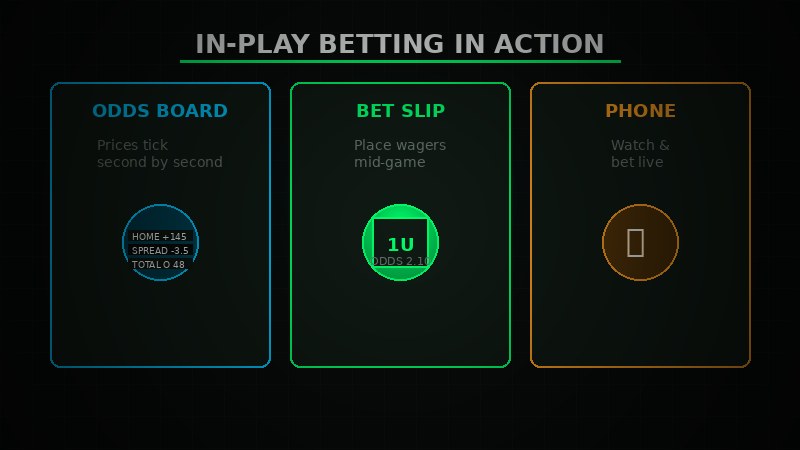
In-play betting involves three simultaneous elements: a live odds feed, your bet slip, and the game itself — each moving independently.
Always compare the live odds you are being offered against the closing line — the odds at market close. If you consistently bet at worse odds than the closing line, you have a structural disadvantage that is difficult to overcome regardless of your predictions.
Reading a Live Odds Feed
A live odds feed shows the best available price from a pool of bookmakers. When you see a price on Gamba Degens' live schedule, it is the median of the available bookmaker prices at that moment, expressed in US (American) odds format. The feed updates throughout the day and shows odds for games in progress.
Reading the feed correctly means understanding what the number represents. A price of -110 on a point spread bet means you need to risk $110 to win $100. A price of +150 means a $100 bet wins $150. The vig on any given market is visible in the gap between the best home and best away price — the wider the gap, the more vig is embedded.
When watching a live game, avoid locking in the first odds you see after an event. The immediate reaction in the odds market immediately after a goal or injury is often an overreaction, and the odds quickly normalise as the market digests the information. Waiting 30–60 seconds before placing a bet after a significant in-game event is a practical way to avoid betting at the worst possible price.
Bankroll Management for Live Betting
The biggest risk in live betting is not the odds — it is the pace. The speed of in-play markets creates urgency, and urgency leads to oversized bets, emotional decisions, and chasing losses within a session. The same bankroll management principles that apply to pre-game betting apply here, with one addition: set a maximum single-bet size before the game starts and do not increase it regardless of what happens in the first few bets.
A practical session structure for live betting:
Before the game: decide on your total session bankroll (the amount you are willing to risk in this session) and your maximum single bet size (typically 1–5% of the session bankroll). Write these down before you open the live odds feed.
During the game: do not increase your single bet size after a win or a loss. The most common mistake in live betting is to treat a win as a signal that the next bet is more likely to win — this is the gambler's fallacy. Each bet's odds are independent of the previous one.
After the game: review whether you stayed within your session limits and whether the odds you received were better or worse than the closing line. This is the most honest measure of whether you have a structural edge.
For a full bankroll framework, see the Crypto Casino Bankroll Management guide.
Play at Gamba.com
Frequently Asked Questions
How do live in-play odds differ from pre-game odds?
Pre-game odds are set hours or days before a match and move relatively slowly. In-play odds update continuously during the game, reacting to events like goals, injuries, time remaining, and market volume. The spread between the best available home and away price is typically wider in in-play markets than in pre-game markets.
Can you consistently beat live sports betting odds?
Beating closing odds consistently — the odds at the moment a market closes — requires an edge that is hard to maintain. The vig built into in-play markets widens the spread further, and the pace of odds movement makes discipline harder. A more practical approach is to focus on specific markets where you have genuine informational advantages, manage your bankroll in fixed units, and always compare the displayed odds against the closing line.
What is the biggest risk in live sports betting?
Impulsivity. The speed of in-play markets creates pressure to act quickly, which leads to sizing mistakes and emotional decisions. The house edge compounds faster in live betting than in pre-game betting because the vig is embedded in a faster cycle of bets. Setting a session bankroll, a max bet size, and a stop-loss before watching a game is the most effective risk management tool.
The Bottom Line
Live sports betting adds a real-time dimension to sports wagering that pre-game betting does not have. The odds react to events as they happen, creating a faster cycle of information, decision, and outcome. The house edge is embedded in the vig, just as it is in pre-game betting, and the pace of in-play markets does not change that underlying structure. What live betting can offer is specific, information-driven opportunities — watching a team's momentum shift in a way the opening odds did not fully price in. Approach it with the same discipline you would apply to any wager: fixed unit sizes, a session bankroll, a stop-loss, and an honest comparison of the odds you received against the closing line. Use code DEGEN at Gamba.com to check the current offer.
Check Current Terms at Gamba.com